



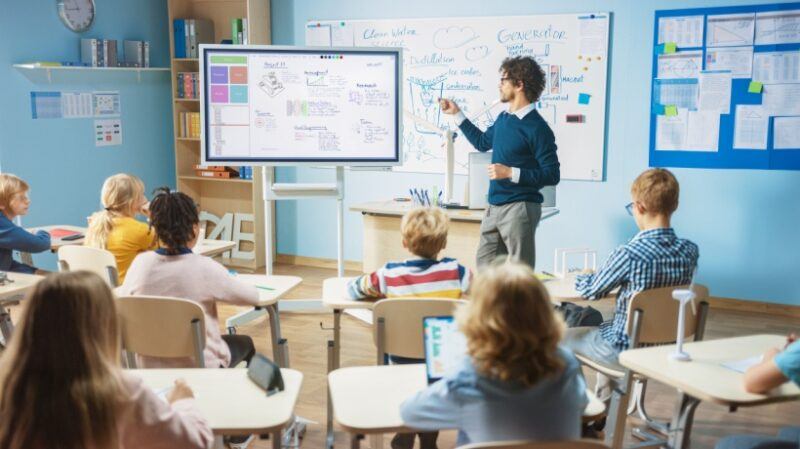
What should the teachers pay attention to when using AI
AI is present everywhere, the way we look for online answers, from how we write, write, or even drive. And now, it is also entering the classrooms. However, AI is not here to replace teachers, but not to help them do better. However, this is not the only technology that has changed education. In recent years, educational tech, such as smartboards, online quizs, and digital books, has become very popular. Today, the latest increase is AI, helping teachers in many ways, such as creating lesson projects and personal learning experiences, grading, tuitioning, and even suggesting materials according to each student’s speed and level.
According to recent studies, more than half of the world are already planning to use or use AI tools. From elementary schools to universities, teachers have increased the burden of work, and AI offers solutions to lighten the burden.
So, what does it really mean to use AI as a teacher? This includes just to support these tools to support their work and to better meet the needs of their students. For example, AI can help you plan a rapid plan of different lessons, developing the ideas of engaging content, or indicating which students may need additional help based on their performance. But, like any device, you should not trust AI with your eyes closed or use it for everything. You should know when and how it can be beneficial. You should also be aware of the dangers and challenges you come up with with AI and how to take advantage of it morally. Let’s follow what you should pay attention to when using AI in the classroom and how you can benefit the most from it.
What should the teachers consider to use the morally AI?
Prejudice and justice
AI learns from data that often reflects prejudice in our world. For example, if an AI tool is trained on materials that mostly represents some cultures or uses old stereotypes, it can accidentally promote these prejudices in the classroom. What can teachers do? First, always review AI-infield content before using students. Then, choose tools that are transparent about your data sources and try to reduce prejudice. To believe the quality of your content definitely, you can add your own content that reflects diversity in AI’s suggestions. Don’t even forget how to find out prejudice.
The privacy of data
AI platforms often require student data to customize learning experiences and track development. Students’ information is sensitive, including names, grades, learning habits and behaviors. When the AI platform collects this data, you should be convinced that it will be safe and is not misused for anything other than education. To stay safe, use reliable AI platform that comply with local data protection rules. Also, always check whether the tool explicitly explains how it uses, stores and protects students’ data. Finally, it is always better to talk to your school’s IT or legal team before using new tools. Most importantly, students and their parents should be informed about how their data is being used, even through the announcement of a quick email or classroom.
Transparency
It doesn’t matter what purpose you use AI as a teacher. You should tell your students. Being transparent helps make technology more understandable and accessible, thus making students more concerned about their use of AI. If you use AI to write articles, for example, students should understand that those samples are AI-generated and not always perfect. Teaching students to criticize AI is part of their preparation for the modern world, where these tools are present everywhere. To stay transparent, it is not enough to only inform students when and how you are using AI tools. When you share AI-Infield content, do this with your own explanations, and encourage students how AI works and where the information comes from. If students are using AI tools themselves, talk about when it is helpful and when it is not.
More dependent
No AI tool can replace teachers. It can quickly create a lesson plan and multiple selection tests, but when a student is struggling emotionally, or offers personal help, it cannot contact the classroom. In the same place you, the teacher, play an important role. Therefore, you should not rely too much on AI. The more you let it handle, the easier is to lose control. So, keep a balance. Just use AI for time -saving tasks, and do not allow it to form your curriculum. Also, check if it is improving things for you, not faster. Finally, do not lose the element of human interaction in your class. Encourage conversation, feedback and cooperation.
Juice
AI has a great potential to improve education by making education more accessible. It can help students with disabilities, language challenges, or different learning preferences. Tools like text -to -speech, real -time translation, and adaptive AI tutors can help students who can struggle to maintain. However, these tools should also be accessible. Not all AI platform is designed with mind adding. Some do not do well with screen readers, others have only English characteristic, and many are not suitable for bad internet connection. This can lead to digital distribution, where only some students can benefit from these resources. Always choose AI tools that support multiple languages, facilitate text, offer audio options, or use fonts that are friendly to people with dyslasses. Don’t forget to test the tools with students with unique needs and seek their opinions.
Practical methods teachers can use AI to enrich their curriculum
Personalized education
Every student is different. Some move faster through material, while others need more time. Learn better in some different ways. AI allows teachers to adjust the lessons to meet each student’s needs, which is a great improvement. How does it work? The AI -powered platform looks at a student’s performance and changes the content in real time. This means that students can learn at their speed without anger or anger. These platform practice recommends questions, videos, or exercises on which every student understands or struggles.
Material production
AI can help prepare ideas for many readings content. You can even play full lessons, work Sheets, or words of words. However, remember that AI is a device, not a teacher. It is important to check everything created. The reason for this is that AI does not always understand the goals of the context, the head or the curriculum. It can also introduce bias or false information, as we have discussed above. Therefore, your role as a teacher is still important. Using AI as a creative assistant does not eliminate your creativity. On the contrary, it can affect you. You can get a lesson idea that you didn’t consider or a new way to present a topic.
Increasing the engagement of the students
Students can be difficult to keep busy, especially with short attention and many disturbances. That is why many teachers are using technology to promote students’ interest and interaction in the classroom. AI tools such as imitation, virtual tutors, and game articles can make more interesting. For example, there are virtual science labs where students can safely experiment. Similarly, foreign languages learn students help them understand the complex text by asking some apps, asking questions and explaining ideas in simple words. Games are also effective. Many platforms use AI to adjust questions based on students’ response. That way, students feel like they are really playing a game.
Opinions and diagnosis
Giving timely and helpful feedback is one of the most important teachers’ tasks, but it takes a lot of time. AI can help it. Many AI tools can grade the quiz, provide feedback, or offer written suggestions to students before offering their work. Some tools can even find samples in the response of students, identify common misconceptions, and create reports that show that the class may need additional help. There are platforms to write assignments, a platform that can check for both grammar and origin. However, remember that while the AI can handle normal tasks, it cannot change your insight. You still need decisions for feedback, results and help.
Classroom management
Teachers have to deal with a lot of administrative tasks. Work can be very high, such as emails, reports, communication with parents, organizing classes, and data tracking. AI can help reduce the burden of this work. Tools can automate parents about homework, lost assignments, or incoming events. If you need to write a report on students’ progress, AI can collect data from the diagnosis and make you a summary for personal nature. The same applies to scheduling lessons. The best thing is that the time you save with AI can be dedicated to your students. You can use it to provide maximum support during lessons, manage leisure activities, or be more in the classroom.
Conclusion
Teachers who wisely use AI are making a better learning experience. They make education more personal, engaged and efficient. By following tech trends, testing tools, and using everything morally, you can prepare the future. So, inquire of AI thinking, ask questions, and share with others what you discovered. And don’t always forget to support human communication, as it cannot be replaced by any kind of technology.
