



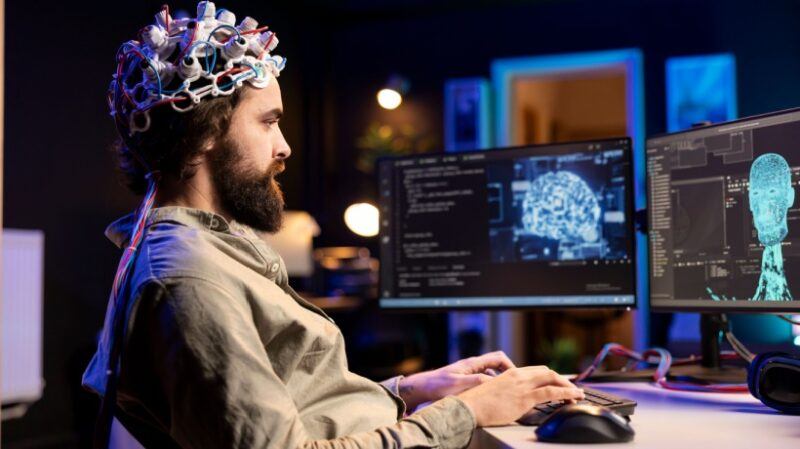
Understanding neuroadaptive learning
Not long ago, the idea of computers understanding how students feel or think seemed like science fiction, but today, it’s becoming a reality. It’s called neuroadaptive learning, and it’s basically a combination of education, neuroscience, and AI. This approach allows the learning system to adapt in real time based on what’s going on in the student’s mind, creating a personalized and responsive experience. For example, a classroom that can sense when you’re losing focus or become overwhelmed and quickly adjusts lessons to keep you engaged could be possible thanks to a brain-computer interface (BCIS). These interfaces act as a bridge between the mind and the digital system, enabling learning tailored to each learner’s unique mental and emotional state.
So, what exactly is neuroadaptive learning? As we said, it’s the perfect blend of neuroscience, AI, and educational technology, designed to create a smart learning environment that responds to brain signals. The ultimate goal of neuroadaptive learning is to make learning more engaging, personalized, and effective by adjusting to how each student learns best. It’s about recognizing that every brain works differently and learning what learners need when they need it.
Some early versions of these systems are already being tested in virtual classrooms and learning platforms, where they monitor engagement and learning pathways in real time. For example, when a student shows signs of fatigue, their lesson may be shortened. If this approach is used more widely, it could help teachers know precisely whether the teaching they are teaching is effective. However, before we begin, let’s take a closer look at the idea and examine how BCIS works in neuroadaptive learning and what the benefits are.
Types of Brain Computer Interfaces
Non invasive
Non-invasive BCIs are the most common type and are the most practical for everyday use, especially in educational settings. This is because they do not require surgery or direct contact with the brain. Instead, they rely on external sensors placed on the scalp to detect brainwave patterns. The most popular form of non-invasive BCI is electroencephalography, or EEG for short. EEG-based devices measure electrical signals produced by neurons in the brain. These signals are very subtle, but with the help of sensitive electrodes, they can be recorded and analyzed to reveal patterns related to attention, engagement, stress or fatigue. EEG headbands are wearable devices that look like headphones. They can read the user’s cognitive state in real time, so even if a student loses focus or they start to feel mentally overloaded, the system can detect these signals and adjust the lesson accordingly. This makes learning a truly personalized experience.
Disgusting
On the other hand, we have the invasive BCI. This is a much more complex and high-risk category that involves the surgical implantation of electrodes directly into brain tissue. These devices provide a much clearer and more precise picture of brain activity because they record signals directly from neurons.
Because of their accuracy, invasive BCIs are mostly used for clinical and research purposes, not education. They have helped people with severe physical disabilities or neurological conditions, as some invasive BCIs allow paraplegics to control robotic limbs, type on computers, or even communicate their thoughts. In these cases, electrodes are implanted in specific brain regions responsible for movement or communication, and signals are sent to external devices that perform the desired action. While the potential of this technology is great, it also comes with serious challenges. Brain surgery is invasive. This increases the risk of infection, inflammation and long-term health implications. This is why such systems are used strictly for clinical and experimental reasons.
Where are BCIs used?
Cognitive training games
BCIS has already started finding its way into classrooms. Although the technology is still new, the ways it’s being tested and used show it could reshape learning in the future. One of the most interesting applications of BCIS is in cognitive training games. These games are designed to strengthen skills like memory, focus, and problem solving, and with the help of BCIS, can now respond to your brain activity in real time. For example, when playing a game like this, your character speeds up when you are fully focused and slows down when your focus starts to increase.
Integration with AR/VR
BCIS can also integrate with SAR and VR. While wearing a VR headset and exploring the solar system, a BCI can track the user’s engagement and emotional state. If it senses that they are losing attention, the system can slow down, offer prompts, or add more interactive elements to re-engage them. The combination of BCI with virtual and augmented reality creates truly immersive, adaptive learning experiences. These tools are being tested in fields such as medical training and engineering, where students can practice complex tasks in a safe, simulated environment while receiving feedback that correlates with their academic performance.
Special education
BCIs are also making a meaningful difference in special education. For students with physical or neurological challenges, these interfaces can offer opportunities that traditional tools simply cannot. For example, children with limited mobility can use BCIs to interact with digital lessons, play educational games, or communicate without the need for a keyboard or mouse. Some schools are experimenting with simple EEG-based devices that help teachers understand when students are feeling overwhelmed or disengaged, allowing them to adjust the pace of lessons in real time.
STEAM TRAINING
In STEM education, pilot programs are using BCIs to support hands-on learning in science and math. Students can receive neurofeedback while solving problems, helping them identify when they feel stressed or distracted and learn how to focus more effectively.
Adaptive testing
Beyond classrooms, BCI has also dabbled in new methods of assessment. Adaptive testing, for example, uses brain signals to determine when a student is struggling or finding questions too easy and then adjusts the difficulty to match their ability level.
Emotional regulation
Emotion regulation is another area where BCIs have proven useful. In neuroadaptive learning, these systems can detect when students are anxious or frustrated and guide them through breathing or mindfulness exercises to calm them down before continuing.
Neurofeedback learning
Finally, neurofeedback learning, where students see real-time visualization of their brain activity, helps them understand how their brains express stress and focus. Over time, this knowledge can help them become more motivated and perform better.
Neuroadaptive learning and the benefits of BCI
Personalized learning
When learning something new, such as a language, a math concept, or even a new app, some things are easily understandable, while others are not. Traditional learning systems don’t address this, but neuroadaptive learning does. By integrating with brain monitoring tools such as EEG headbands that read electrical activity in the brain, the system can detect how focused or mentally tired a student is and adapt accordingly. If one loses focus, the system can then slow down, simplify the content, or make the content more engaging. If a student is finding the subject easy, the system can increase the level of challenge.
Increased engagement
Staying focused on learning for long, especially with so many distractions, is difficult. Neuroadaptive systems help with this, as they sense engagement. When they sense that users are losing interest, systems can react by suggesting interactive quizzes, short videos, or even mental breaks. This creates a more responsive learning experience that keeps students engaged rather than bored.
Cognitive insight
Neuroadaptive learning helps both students and teachers understand how learning occurs on a cognitive level. Instead of guessing whether a student is struggling, tired, or stressed, teachers can see patterns in real time. For example, BCIs can detect changes in brain activity that are related to stress or mental overload. If a student is showing signs of fatigue, the system can recommend short breaks or easier tasks. Teachers can use this information to design better lessons that match students’ pace. Over time, this data helps build a detailed profile of each learner’s cognitive behavior. This, in turn, helps teachers understand when and how each person learns best.
access
Neuroadaptive learning and BCIS can make education more accessible for people with disabilities. For learners who have physical challenges, communication barriers, or neurological conditions, traditional methods can be limiting. But BCIS can help. Let’s talk about students who are unable to use a keyboard or speak because of mobility disorders. They can use non-invasive BCIs and control computers or navigate digital lessons using only their thoughts. BCIS can also help those with learning differences such as ADHD, dyslexia, or autism. By recognizing when attention drops or stress increases, neuroadaptive systems can tailor the environment to keep the environment relaxed and focused.
Better results
Ultimately, all these benefits combine to improve learning outcomes. When content is tailored to the learner’s brain activity, students are more engaged, less confused, and understand the learning material better, according to studies. After all, when students are not distracted, tired, or disinterested, their minds are free to fully focus on the information. Therefore, learning becomes more rewarding, which can change how students view education.
The result
The exciting part about neuroadaptive learning is not just how the technology has advanced, but also the fact that we can understand how humans actually learn. However, although neuroadaptive learning offers us amazing possibilities, it also raises important questions about privacy, ethics and data security. How do we protect something as personal as mental data? This is where stakeholders must collaborate to create ethical and inclusive policies that keep learners safe.
