



Walk for Peace has, in many ways, been easy to miss. There is no slogan, no sign, no action.
Instead, there is only walking. One step, then another. Breathing in and out. Bodies move continuously through spaces designed for high speed.
After 108 days and more than 2,300 miles of travel, Buddhist monks and their beloved dog Aloka have reached their destination in Washington, D.C. On February 11, 2026 — day 109 — they will host a global loving-kindness meditation at 4:30 pm EST.
Our current culture is shaped by loud, restless things: urgency, anger, and constant stimulation. This long-distance pilgrimage across the United States offers something distinctly countercultural. It is quiet, stable, unassuming, and attentive.
It’s a (sometimes uncomfortable) reminder that our ideas about peace are often future-oriented and external. We imagine a time that isn’t here yet, where the horrors that plague us end, and we can finally feel okay.
I live in Minneapolis, right downtown. There is no peace here. We are surrounded daily by realities that are unstable, uncertain, and terrifying. In the midst of it all, people here are quietly nurturing a web of care that extends to neighbors and strangers alike, stubbornly insisting on the possibility that we belong together.
What I see is that we are starved for softness in a world that appreciates dominance and control. We suffer from compassion in a world that keeps telling us that softness makes us weak and flawed.
This past month, I’ve found myself checking in with Walk for Peace several times a week. I watch videos of such gentle interactions as people watch these monks pass by, sometimes offering flowers or just an encouraging hello. They cry uncontrollably, and so do I.
What I see is that we are starved for softness in a world that appreciates dominance and control. We suffer from compassion in a world that keeps telling us that softness makes us weak and flawed.
It is difficult to sit with this truth, but also strangely empowering that the monks are embodying. Something changes in me when I begin to think about peace, not as something “out there,” but as something that begins as a tiny ember in each of us—something we feel like an ember, ignite with our own breath and attention, and then intentionally carry with others—moment by moment, step by step.
What is Walk for Peace?
The Walk for Peace is a long-distance walk across the United States, led by a small group of Buddhist monks and supported along the way by volunteers and community members. The walk’s route spans more than 2,000 miles, starting in Fort Worth, Texas and ending in Washington, DC, crossing ten states along the way.
Although it draws from contemplative Buddhist traditions, the walk itself is not a religious ceremony. It is a living experience of mindfulness, compassion and non-violence expressed through the simple act of walking.
At its core, the walk is a dynamic mindfulness practice. Participants walk mindfully, often in silence, each step allowing them to re-anchor themselves in the present moment. For observers and those briefly involved, the experience can feel unexpectedly grounded. There is nothing to argue with, nothing to agree or disagree with. It’s just people moving cautiously through space, which is totally unremarkable on the surface—but somehow feels like the most revolutionary thing ever.
By walking mindfully in public spaces, participants develop an alternative way of being—one that does not require agreement, belief, or commitment. With each step, they just seem to say, Watch your breath, watch your pace, watch the people around you.
Unlike marches designed to persuade or protest—and of course they have their place—the Walk for Peace has no demand. It invites reflection rather than reaction. Many people who experience it describe a sense of calm or curiosity. It’s a remarkable break from the usual mental clutter of everyday life.
Rather than focusing on specific political outcomes, the walk focuses on something more fundamental: how people relate to themselves and to each other in everyday life.
As a deliberate mindfulness practice, the walk highlights several important principles:
- to slow down In a culture that rewards speed.
- Embodied AwarenessUsing movement as an anchor for the present moment in a culture that often uses distraction and indifference.
- Compassionpracticed through respectful presence rather than persuasion.
- Non-violencenot only as the absence of harm, but as a deliberate orientation toward care
By walking mindfully in public spaces, participants develop an alternative way of being—one that does not require agreement, belief, or commitment. With each step, they just seem to say, Watch your breath, watch your pace, watch the people around you.
Peace, in this context, is not an endpoint, but a capacity that grows with practice.
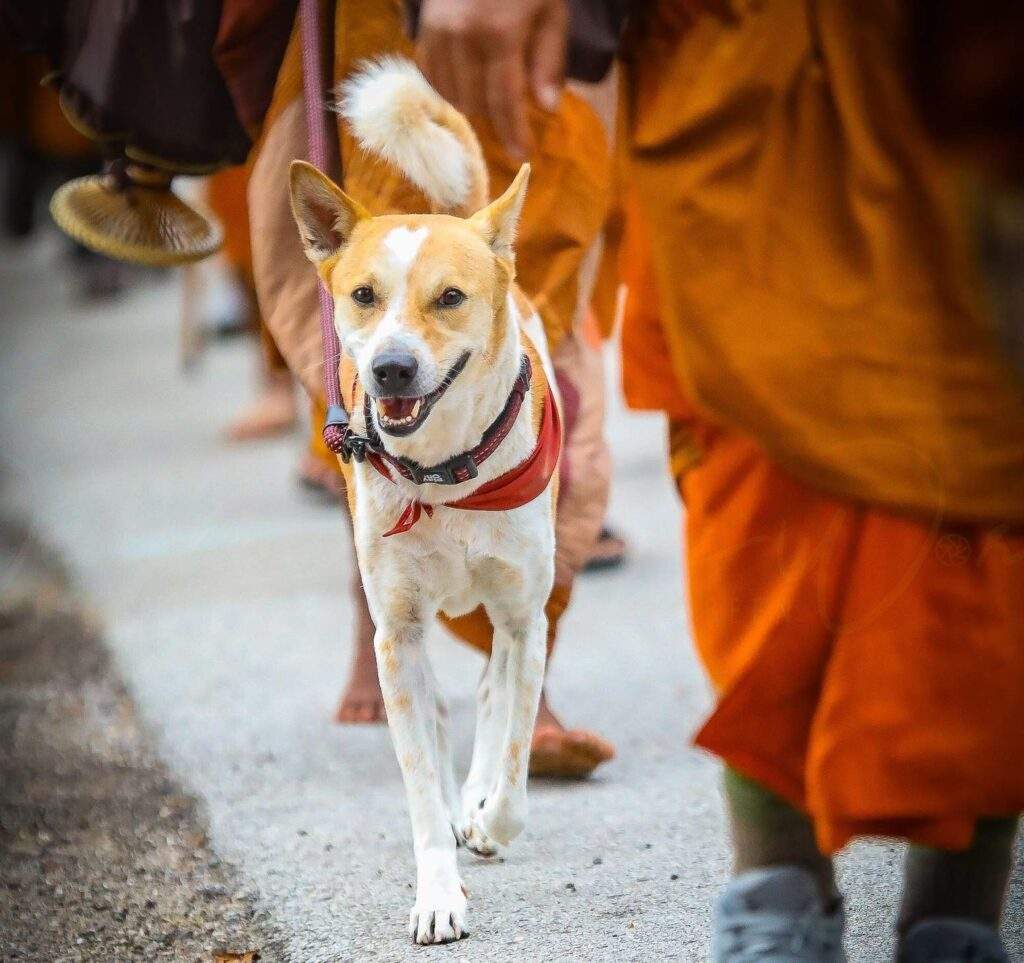
The first step
Walking has long been associated with reflection and insight. It naturally regulates the nervous system, invites awareness of breath and sensation, and brings attention out of abstraction and into the body. By choosing walking as their medium, the organizers base their response on something universally human.
Walk for Peace began with a simple question: How do we respond to a world marked by division, tension, and suffering without making more noise?
In an informational ecosystem shaped by influence and social media, we are accustomed to slogans and sound bites, to people trying to talk to us, to shape how we think and feel. But these monks are not giving any message. To People are living from a practice. between them
Instead of issuing statements or organizing events, they chose to walk—slowly, visibly, and steadily—through communities shaped by the stresses and strains of modern life.
Parts of the walk, through places like Selma and Montgomery, Alabama, traced the steps of leaders of the civil rights movement.
What is it like for us, for generations to come, to see humble people spreading compassion and healing on such a hurting land, witnessing the truths and bearing the wounds that we have yet to collectively confront?
The steady gaze, pace and breath of monks-like people remind me (that) no one person is enduring it all alone. Together they are carrying and surrendering, rejoicing and connecting, witnessing and walking.
I drive through Minneapolis and see the trauma of racial violence in real time: tired but determined people holding signs on street corners, begging for mercy and humanity. “Closed” signs in business windows where workers have been moved. A car was parked on the road, the driver’s side window was broken, the door was still open. Has anyone seen this happen at least so the owner’s loved ones can be notified.
This moment is painful to witness, to look into the eyes. I want to turn away. My chest feels like I’m sinking. But the steady gaze, pace and breathing of people like monks reminds me of two important things.
First, the longer we resist offering our attention to these unhealing places, the more we live in the echoes of the same wounds over and over again. Different possible futures are only possible by our loving awareness of what is already happening. right nowEven (perhaps especially) when it’s at a level of grief, hopelessness, or anger that we’re not sure we can handle in the moment.
Second, no individual is enduring it all alone. There is no do-it-all hero. Together they are carrying and surrendering, rejoicing and connecting, witnessing and walking.
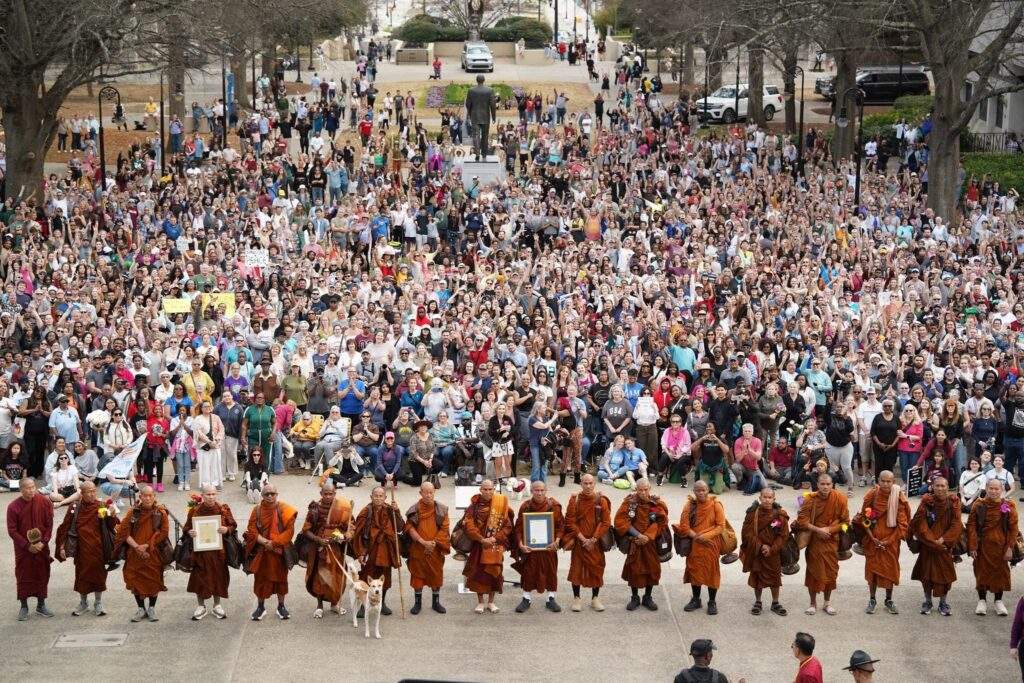
How do people respond?
In many communities, people have gathered along the way—sometimes in the hundreds, sometimes in the thousands—who gain less through promotion than by word of mouth and curiosity.
Some offer food or encouragement. Some people walk quietly for a stretch, or just stand and watch.
Online, the walk has attracted millions of followers. Photos and short videos of monks wading through rain, heat and traffic circulate widely, often accompanied by comments describing a sense of calm or inspiration.
Some are skeptical, questioning whether walking in a world facing complex systemic challenges can have any real impact.
This tension is also familiar in mindfulness circles. Practices that emphasize inner awareness are sometimes dismissed as passive or inadequate. I understand skepticism, even as research and lived experience increasingly suggest that focus, regulation, and empathy are not luxuries—they are essential to wise practice.
Many people who experience the walk do not report dramatic changes. They describe something smaller and perhaps more enduring—a gentle conversation, a deeply visceral experience, a reminder to slow down. Again: We often seek drama because we’re conditioned for it — but maybe what heals us is manifested in a thousand quiet, non-social media-worthy moments.
To be at peace when peace feels absent
Walk for Peace does not claim to be a solution to global problems. It does not promise instant results.
What it presents instead is a living question: What changes when we choose to go into the world with awareness and care?
Peace is not something we wait for, hoping for an improvement in external conditions, but something we practice within our own circumstances.
Mindfulness practice is rooted in such fundamental things – the breath, the body, the next moment. The mind wanders, as it always does, to other things. I wonder what will happen these days to my neighbors, my friends, my anxiety and anger, the work that needs to be done, my city, my country.
My practice has never been fancy, and even over the years, I’ve always been more conscientious than skilled. Sometimes the tears spill, and my practice is like a cold hand on my forehead, like a comforting mother, calling me home.
Walk embodies this homecoming on a collective scale. It shows that peace is not something we wait for, hoping for improvement in external conditions, but something we practice within our own circumstances.
I know the walk is coming to an end. In all honesty, I will miss the photos and videos. They have been a kind of nourishment during these long, dark weeks.
I also know that something real happened between real people. Perhaps for the first time in a long time, we have a glimpse of what happens when we stop for just a few moments, and look at each other. On the surface, it’s so small it’s almost nothing, just a breath or a blink of an eye or a step—but I swear I can make that spark of compassion jump from one person to another. I feel it here, and I know it matters.
