



When I boarded a 10-night Mediterranean cruise, I expected a slow, easy journey. Turns out, I was wrong.
In just one week, I visited 11 ports in Turkey, Italy, Greece, Croatia and Montenegro, an itinerary that would have been exhausting if I had attempted it by air and land. It made me realize that a cruise can be one of the most efficient ways to see the Mediterranean — especially if your goal is to visit multiple destinations in one trip rather than staying in one place.
I love a packed itinerary, and the extra stress doesn’t bother me. I’ve slept in airports more nights than I care to admit. I’ll take an eight-hour bus ride, followed by three train connections like no problem. But on a cruise, I was able to see a lot without having to repack my suitcase or navigate multiple airports.
I also found that cruises were no more expensive than air or land travel. Norwegian Cruise Line hosted my sailing on the Norwegian Viva and covered my fare. But when I independently priced similar trips with other travel methods, I found it comparable to regular cruise rates.
The geography of the Mediterranean makes transportation difficult.
Unlike most of mainland Europe, which is well connected by trains, buses and budget airlines, the Mediterranean is scattered with islands, peninsulas and borders. Traveling between destinations can be slow, expensive and incredibly complicated.
In chronological order, here are the stops I made on my cruise:
Istanbul, Turkey: The starting point of our cruise, which is ideal given the number of flights into the city.
Kasadasi, Turkey: A short trip from the ancient city of Ephesus, which has a strong biblical history.
Santorini, Greece: An island famous for its whitewashed buildings with iconic blue domes.
Mykonos, Greece: An island known for its glamorous beach clubs and nightlife, as well as its famous windmills.
Katakolon, Greece: Gateway to Olympia, birthplace of the Olympic Games.
Corfu, Greece: A lush island with some of the most beautiful waters in the world.
Kotor, Montenegro: A medieval walled city with a strong reverence for cats (yes, there’s a cat museum).
Dubrovnik, Croatia: As a filming location for “Game of Thrones,” it attracts plenty of fans, but it has long been known as the “Pearl of the Adriatic.”
Ravenna, Italy: Famous for Byzantine mosaics.
Zadar, Croatia: A coastal city with impressive public art along its waterfront.
Trieste, Italy: Famous for its coffee.
Consider traveling solo among the Greek islands. Traveling from Santorini to Mykonos usually requires a ferry which takes two to three hours and costs around $100 per person depending on the season and type of ferry.
Then there are paths that are far more difficult. It is virtually impossible to get from Corfu, Greece to Kotor, Montenegro, as there are no direct flights or ferries between the two. The most realistic option is a drive of about nine hours.
The biggest advantage of cruising was time. A one-hour flight typically takes three times as long when you factor in airport travel, security, boarding, possible delays and baggage logistics. Likewise, check-in for ferries, trains and hotels can take longer than you think. Independent travel also means frequent packing and unpacking.
In Santorini, our ship arrived at 6:30 am and I was ready to go right away. My husband and I hiked from Fira to Oia and covered over 20 miles when we got all our moves right.
We maximized every hour, including watching the sunset in Fira until the 10pm departure of the ship. I came back on board exhausted, had another dinner and collapsed. The next morning, I woke up in the same room, refreshed and already immersed in Mykonos.
In comparison, independent travel requires waking up early, packing, checking out, navigating the ferry port, waiting, spending hours on the water with luggage, checking into a new hotel, and only then starting to explore — already exhausting.
Cruises don’t have to be expensive.
This $283 rate includes:
Some extras – like drink packages or spa visits – will add to the cost, but the same can be said for land-based holidays.
On cruises, accommodation and transit between cities are included in the fare. When traveling independently, both are the most expensive line items.
Here’s how much my hypothetical air and ground itinerary would cost:
Hotel price: $2,350. I priced a hypothetical independent trip using midscale hotels such as Hilton DoubleTree properties with nights in the same cities as the cruise.
Santorini was the most expensive, with hotel rates averaging $450 per night during peak season, according to TripAdvisor.
Basic transportation costs: $2,200. I included the most practical options for transportation between destinations, including a ferry between Santorini and Mykonos, a rental car to drive up the Adriatic coast from Kotor to Trieste, Italy with stops in Dubrovnik and Zadar, and the cheapest available flights between certain cities, often on Ryanair.
Cost of meal: $800. I also budgeted $40 per person for food, which felt conservative compared to the high-end nature of cruise dining.
Tips and airport ride: $310. I also factored in tipping at hotels and estimated taxi costs to and from airports. For tips, I factored in a few dollars for housekeeping and the bell desk each night, especially if the bell desk was storing my bag after checkout. (On a cruise, tips are almost always included in your cruise fare.)
Final price: Based on my estimates, the air and land itinerary would be around $5,660 – almost exactly the same as the cruise fare of $5,658. And that comparison didn’t factor in the convenience of getting to your next stop while you slept.
Prices can vary depending on when and how you book, and it’s possible to find better rates on any type of trip. But overall, I found that the price difference could be relatively small, while the time savings were huge.
The most valuable amenity on a Mediterranean cruise isn’t the food or the entertainment. How long does the ship stay in port?
We were in Santorini from 6:30am to 10pm, which allowed for a full, active day without feeling rushed. Meanwhile, I saw other cruise ships arriving in the early afternoon and departing in the early evening (barely time to take the cable car to Fira before heading back!).
NerdWallet’s analysis found that among cruise lines with three or more Santorini port stops in July 2026, Norwegian Cruise Line, Celebrity Cruises and Windstar Cruises spent the three longest periods in port.
When Mediterranean Cruises Don’t Work
A cruise is not the right choice for every trip.
You won’t get more than one day in one place. Destinations from coastal ports that require multi-day hikes or deep inland exploration. While I loved my stops in Croatia, my favorite part of the country, Plitvice Lakes National Park, was too far inland to fully enjoy on the cruise schedule.
Some cruises stay in port overnight, which is difficult if you want to take in the nightlife in places like Mykonos and Ibiza.
After hiking for a day in Kotor, Montenegro, and discovering a cheese shop in the mountains with goats roaming outside, I immediately knew I wanted to return. In this sense, cruises serve well as a model, helping travelers decide which destinations are worthy of future, longer stays.
Delays in the tender may reduce your travel time. While I was in Montenegro, a storm forced the tender boats to stop for about an hour before the worst of the weather passed. When the tenders started again, the lines got longer. Still, I’ll take a tender delay over a plane or train delay any day.
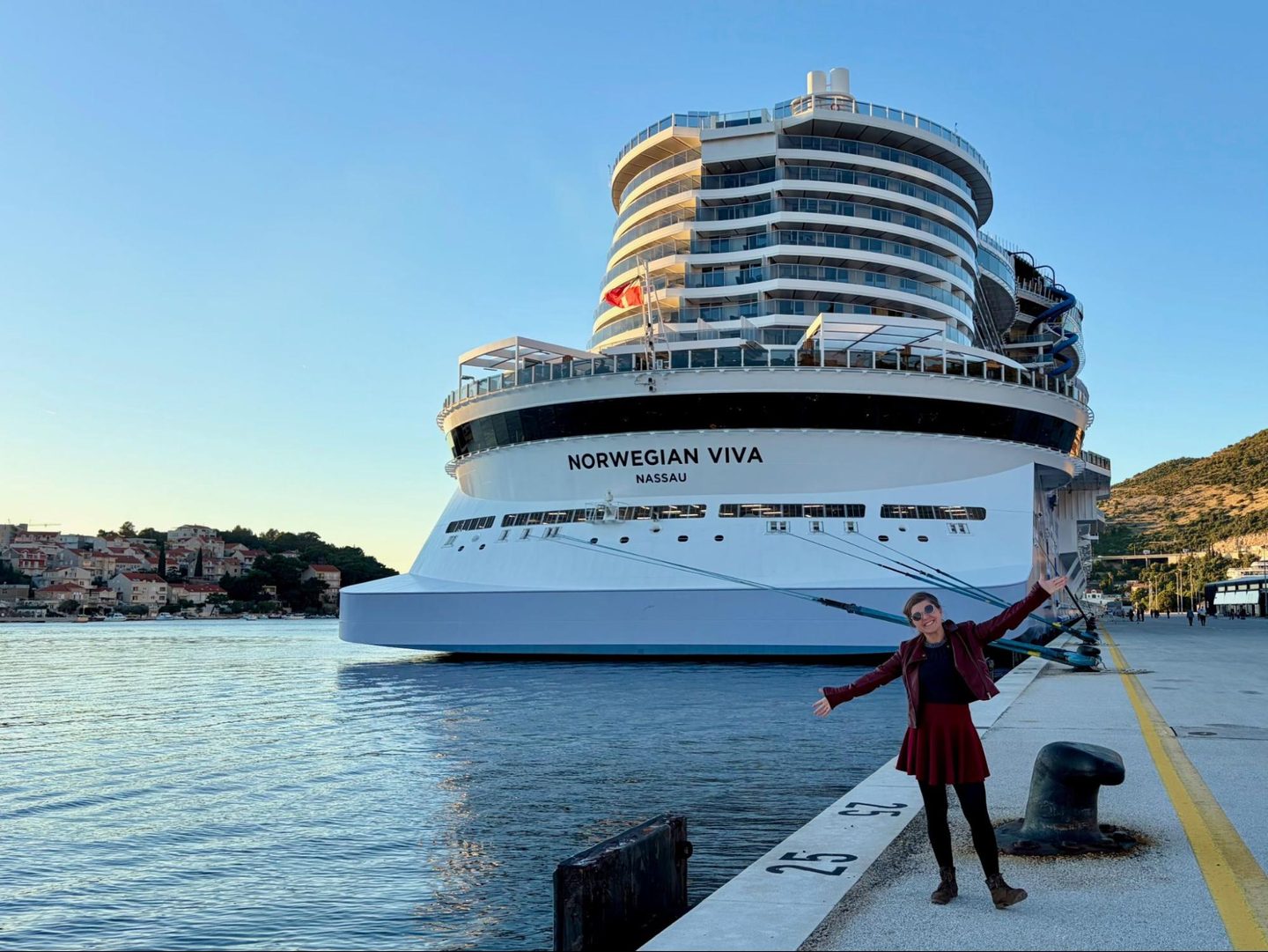
Am I now a cruise convert?
I really began to appreciate the convenience of shipping when our return flight from Trieste, the last port of call on our trip, was canceled with little notice. With no viable alternative flights, we took the nearly two-hour train to Venice Marco Polo airport for the alternative flight. That train was delayed an hour (of course), and we almost missed our flight.
It was a sharp reminder of what I had avoided for 10 days: flight disruptions, baggage transfers and logistical dependencies.
I still love independent travel, and I’m definitely not converting to the cruise-only life. But after comparing costs and stress levels, I can’t deny that multiple Mediterranean destinations in one trip made cruising a lot easier than trying to replicate the same trip independently.
For travelers who want to efficiently see multiple Mediterranean destinations, a cruise deserves serious consideration – even by people like me who never thought they’d say it.
