



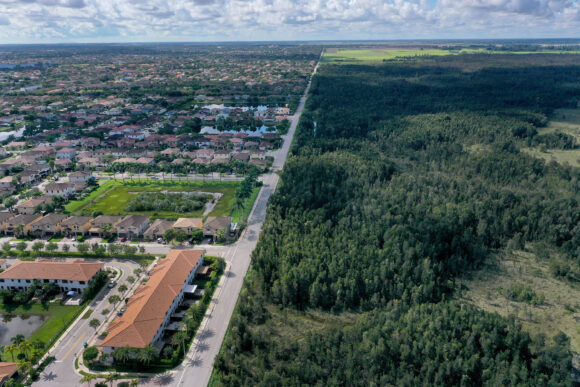
Florida lawmakers who say they want to encourage the construction of more affordable housing are trying to take away powers that Miami has used for decades to keep developments, strip malls and warehouses out of the Everglades.
A land-use bill, HB 399, which passed the Florida House on March 3 and is being considered calls for the state Senate to study the possible elimination of the 78-mile-long urban development boundary, which has defined where Miami ends in the west and the Everglades begins since 1983. A vote in the Senate is expected on Wednesday.
The Everglades is a vast subtropical wetland that acts like a giant sponge, soaking up floodwaters and filling an underground lake that supplies drinking water to about 9 million people. Conservationists argue that construction in the Everglades will limit its ability to absorb excess rainfall and threaten the region’s fresh water supply.
“This legislation threatens the open land we need for the future,” said Rachel Silverstein, who heads Miami Waterkeepers, an environmental advocacy group. “Without high barriers, we will flatten our Everglades, wetlands and farmland, endangering our drinking water supply and making flooding problems worse.”
To build beyond the line, developers currently need the support of nine of Miami-Dade County’s 13 commissioners. The new legislation would reduce that threshold to a simple majority.
Opponents say the measure could make it more difficult for towns and counties in other parts of Florida to enact similar limits to protect wetlands and agricultural land from sprawl, extending state leaders’ current approach that is eroding local control over zoning, schools and other issues.
Since Ron DeSantis became governor in 2019, the Florida Legislature has taken away powers from cities and counties, including preventing local leaders from banning plastic straws, forcing conservative agendas on public schools, and requiring local police to detain immigrants.
“There are multiple versions of these preemptive bills that take away our powers,” said state Rep. Anna Escamani, a Democrat who represents Orange County and parts of Orlando.
In 2024, 73% of Orange County voters approved a limit protecting rural areas from high-density development. If passed and signed into law, a land-use bill could throw that boundary into doubt. At least 20 counties in Florida have similar measures to limit the spread that could be weakened by the bill.
“The law is against the will of my constituency,” Eskimani said in an interview.
The bill’s sponsor, Republican Rep. David Borrero, said his proposal would provide more affordable housing. “If you let the free market operate, you’re going to drive housing prices down a lot,” Borrero, who represents Hialeah, a dense, heavily Hispanic city in Miami-Dade County, said during the debate on the measure.
Borrero did not respond to requests for comment.
However, supporters of maintaining the border reject this notion. Laura Reynolds, science director of the Hold the Line Coalition, an environmental advocacy group, said homes built in the area would be far from jobs and require expensive taxpayer-funded infrastructure like new roads.
The legislation has sparked a wave of lobbying. Thirty-six cities, counties, advocacy groups, developers and builders have registered lobbies to work on the bill. The list also includes billionaire Joe Lewis’ Tavistock, whose Lake Nona development is Orlando’s largest, home to 64,000 people.
A representative for Tavistock declined to comment for this article.
Homebuilder Lennar Corp. has built a number of housing developments near the Everglades over the past few years, and its chief executive officer, Stuart Miller, said Miami’s urban sprawl is antiquated and in need of an overhaul. He said Lennar has been engaged in discussions about this issue for years.
“I generally believe in the strictest laws that live for many, many, many years, probably outlive their benefit,” Miller said. Lennar is interested in “expanding housing capacity so that more people can afford housing,” he said.
Not all developers want to get rid of restrictions. In Miami, billionaires Jorge Perez and Armando Codina have publicly opposed the idea as a threat to smart planning and safe drinking water.
The line “is not an obstacle to development; it is a rail protecting Florida’s future,” Codina wrote in an op-ed in the Miami Herald last month.
Top image: Urban sprawl near protected wetlands at the edge of Everglades National Park in Miami-Dade County, Florida in 2021. (Joe Riddle/Getty Images/Bloomberg)
Copyright 2026 Bloomberg.
Topics
Florida
