


We often hear about inner peace, but it can be much more than a moment of peace after yoga or a perfect massage. Inner peace is our ability to let go of attachments and reactions to life events, resulting in ease and clarity.
As a mindfulness skill, inner peace is the ability to let go of attachments and reactions based on an understanding of impermanence—the changing nature of our thoughts, emotions, and desires. When we find ourselves rushing and reacting, we remind ourselves, This too shall pass.. The goal is not to deny what we’re feeling, but to put the brakes on the fast-moving emotions. Once we return to our inner stillness, we can look at the source of our reaction, see its changing nature closely: this is what sets us free.
Once we return to our inner stillness, we can look at the source of our reaction, see its changing nature closely: this is what sets us free.
As a practice, inner peace is the art of stopping, observing and letting go for the purposes of healing and clarity. It includes physical relaxation and mental relaxation. It can be seen as the ultimate balm for your soul — like a cool breeze on a hot day. Inner peace brings ease to body and mind alike. In the body, muscle relaxation is experienced as an overall sense of ease. In the mind, inner peace creates space to hold everything without restraint or resistance. Conversely, the absence of inner peace can manifest as restlessness in the body and agitation or reaction in the mind.
The search for inner peace can often leave us wanting more, but ironically, true inner peace is achieved when we let go of our desires, even the desire for inner peace. This paradox becomes clear when we consider the case of a client struggling with anxiety who turned to meditation to calm his mind. Surprisingly, he found himself even more restless after meditating. He hoped that meditation would improve his sleep, but was disappointed when he observed his restlessness during body scan meditation, which seemed to exacerbate his sleep problems.
The moral here? In order to find peace, he had to first let go of his expectations around finding peace. To let go, she learned to see three obstacles to her mindfulness pursuits: running in circles (a restless mind), pulling (trying to sleep) and pushing (frustrated by her restlessness). With practice, he learned to accept his restless mind, which softened the struggle and frustration, and he was able to find ease, even when he couldn’t sleep, which eventually allowed him to sleep.
However, letting go of attachments to certain outcomes does not mean that we are suppressing or avoiding difficult situations. Instead, this release occurs organically when we perceive the emotion as arising and dissolving—all within ninety seconds.
The ninety second rule
Inner peace is not about suppressing, denying, or avoiding our emotions. When we don’t accept the urge to react, we are developing the capacity to be unpleasant (knowing that emotions are physical responses in the body that arise and dissolve). Just as happiness caused by external events does not last, negative emotions also do not last. Have you heard of the ninety second rule? Neuroscientist Jill Bolte Taylor revealed in her book. My Stroke of Insight: A Brain Scientist’s Personal Journey That all emotions have a beginning, middle, and end—all within ninety seconds of when they first arise.
The reason we continue to experience negative emotions, sometimes for days, weeks, even years, is because we amplify those feelings through our narratives. Instead, if we stop and let the emotions move into our bodies, we create space in our minds to better understand what they are trying to tell us. Instead of suppressing or using positive thinking to bypass our experience, we can establish unity with our emotions. By doing so, we can discover how they are trying to protect us, satisfy our unmet needs, or direct our attention to new information in the environment.
The ninety-second rule is a helpful reminder to ride the waves of our emotions, but emotions can sometimes be so powerful that they hijack our rational thought processes. In these situations it’s helpful to remember where those emotions come from—back in the day, when we hunter-gatherers encountered real lions!
How inner peace supports resilience.
Much of our lives are marked by perceived threats to our identities, careers, or relationships. Our primary response—the fight-flight freeze—can be unhelpful when it comes to navigating these everyday psychological and social stresses. What is needed to solve common problems in the modern world is clarity and creativity, but our response is the opposite—fight, flight, or freeze. This evolutionary response to any threat is automatic and unconscious.
What is needed to solve common problems in the modern world is clarity and creativity, but our response is the opposite—fight, flight, or freeze.
When our emotions become so active that we can’t think or see clearly, it’s called an “amygdala hijack”—a term popularized by emotional intelligence expert Daniel Goleman. The amygdala is the emotional center of the brain. One of its functions is to scan the environment for threats and prepare the body for an emergency response. When it senses a threat, such as a tiger lurking in the bushes, it sends immediate signals to release stress hormones—adrenaline and cortisol—that amplify the emergency response. Blood stops flowing to the organs and instead flows to the organs to prepare us for fight or flight. Meanwhile, the prefrontal cortex (which is responsible for thinking and executive decision-making) shuts down because there is no time to think and analyze when we are facing what the brain perceives as a life-threatening situation.
During an amygdala hijack, it is said that our IQ temporarily drops by ten to fifteen points. Maybe this explains the feeling we have when we react to a verbal stimulus: What was I thinking when I said that? That’s exactly the point. We stop thinking rationally. It also compromises memory, which is why we can’t remember a single good thing about someone we had a conflict with or why we can’t find our keys during a panic attack. Being in a constant state of fight or flight against modern threats also compromises the integrity of other systems, such as the immune system and digestion.
Cultivating inner calm is an important step in avoiding an amygdala hijack so we can think clearly even in highly charged situations. Using exercises to promote inner calm — such as breath awareness — helps calm our heightened emotions and allows the parasympathetic nervous system to return so we can think clearly again. Another activity that rewires the prefrontal cortex is “noting” or “labeling.” Noting or labeling our emotions gets the prefrontal cortex to regain healthy communication with the amygdala and avoid hijacking. Inner peace provides opportunities to learn and improve or gives us a deeper understanding of the “what” and “why” behind our actions. We can replace tension and misunderstanding with harmony and understanding. Inner peace is the key to resilience in relationships and life in general.
Where are you on the inner calm continuum?
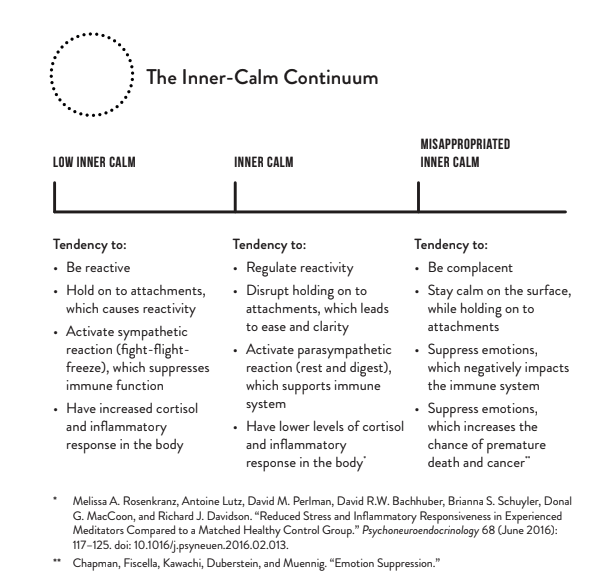
You can strengthen your capacity for inner peace, regardless of your circumstances. First, notice when you are calm and when you are not. Next, consider the reasons and conditions that promote calmness and what prevents you from being calm. By developing the habit of calming the mind and body, you will develop the ability to access this space more quickly and easily.
Daily practice: One minute rest
Relaxed, we care about the right things again and
The right people in the right way.
– David White
Take time throughout your day, several times a day, if possible, to empty your cup and make room for the things that matter. You can do this very quickly by checking in with your body.
- Any tension or tightness in the body is a clue. That you are holding onto something that needs your loving attention. You cannot let go without knowing what it is you are trying to let go of. Simply bringing your attention to the places where you are stressed can help you uncover the feelings and thoughts associated with that stress.
- Once you can see the cause of your stress.you can find the solution. It’s also defining realignment with your intentions as you empty your cup—what are you making room for?
- return. Rest for a minute. And come back to your body. Rub the palms of your hands together and place them over your eyes, letting them relax. Move your hands to your jaw, neck, shoulders, chest, or wherever feels good on your body.
- listen. Listen from within. What can you let go of in this moment to make room for what matters?
- Start. Begin your activities with a relaxed body and mind. Connect with what matters.
Try practicing and playing with this reminder with your family, team members, and in your community before starting a meeting or activity together.
Excerpt from the book Back to Mindfulness: Disrupting Default Habits for Personal Fulfillment, Effective Leadership, and Global Impact Copyright © 2024 Shalini Bahl Milne by Shalini Bahl Milne. Reprinted with permission of the author. Return to Mindfulness will be available on Amazon on January 18, 2024.