



Over the past year, I’ve had hundreds of conversations with business leaders about AI. The pattern is always the same. They are not short on tools or desire. They struggle with where to start and how to get value.
The pressure to adopt AI is real. But pressure without direction leads to experiments that don’t stick, tools that don’t get used, and teams that grow more skeptical. Why? Because the AI output did not lead to real results.
Here’s what I’ve learned from watching teams that succeed with AI: They don’t start with AI. They start with a problem. A specific, painful, time-consuming part of their job that they want to fix. Then, they find the right AI use case to achieve that goal. As they see results, their confidence grows, and they explore other AI capabilities – again, tied to a clear purpose.
This is the perspective I want to share. Not an exhaustive list of everything AI can do, but a practical guide where marketing, sales, and service teams can get started and see real value with AI. For transparency, we’ve organized the use cases in terms of how developed the technology is today. At HubSpot, we’re building and improving these capabilities every day. Let’s start with simple definitions:
- Established: These are the use cases where AI works reliably. Implementation is straightforward. Results are repeatable. If you’re wondering where to start, here it is!
- Emerging: These use cases are available today and are rapidly improving. They are providing value, but are still evolving. As AI gets more data and context, they will become more powerful.
- Initial: These are high potential use cases that are still taking shape. If you consider yourself an early adopter, this is where you can (with patience) experiment.
Go to the use case that matches your team’s biggest challenges:
Use cases for marketing.
Use cases for sale.
Use cases for service.
Use cases for marketing.
Marketing teams are under pressure to do more with less. More channels, more content, more personalization. All without the highest head count. But AI is helping marketers reimagine how they accomplish all of these tasks. Here are the use cases teams can implement now and in the near term.
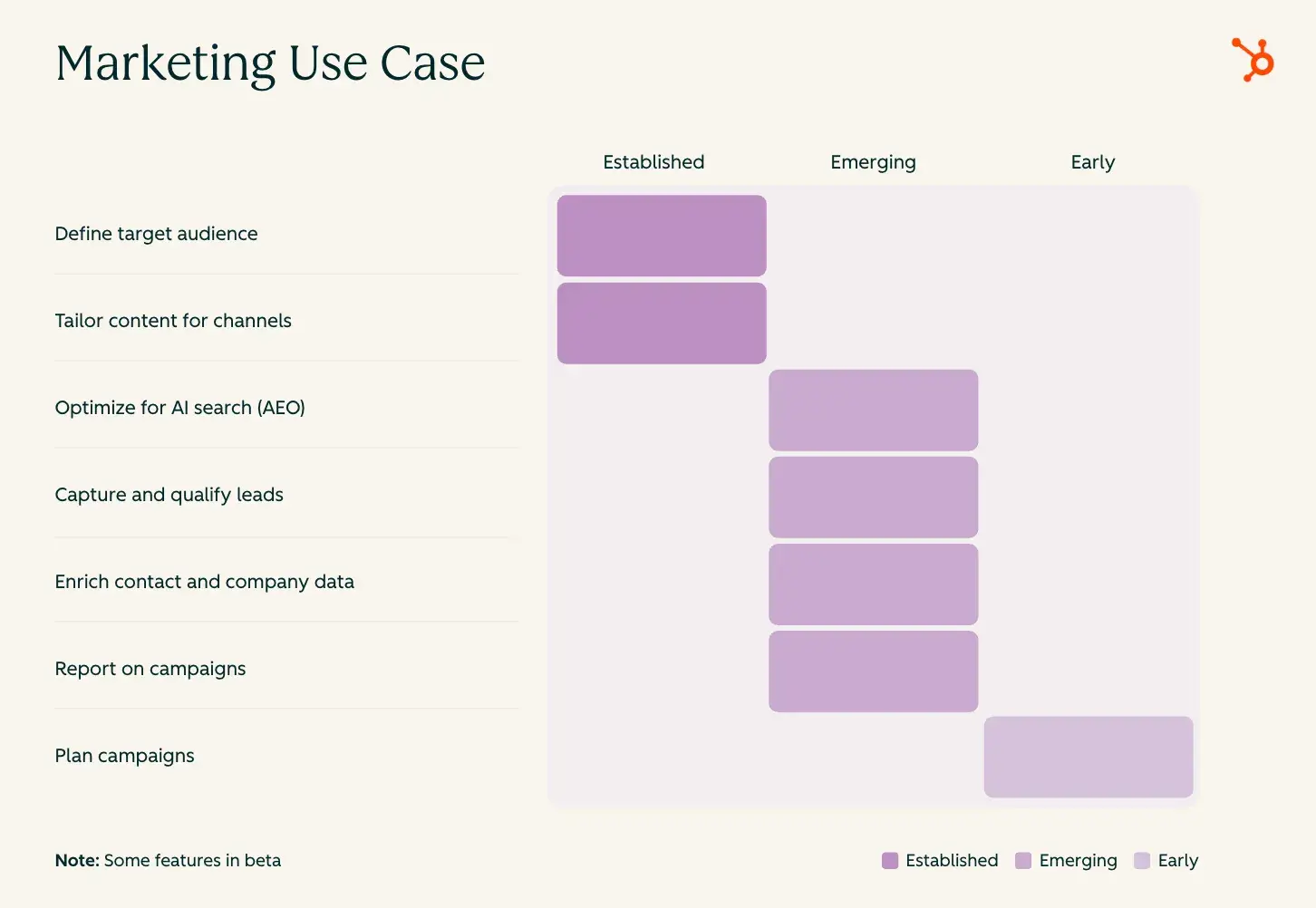
established
Define the target audience. Most segments are created based on job titles and company size, but that doesn’t tell you who actually buys. AI helps you find the right fit prospects that are most likely to convert. HubSpot customers can use Breeze Assistant to better understand customers, optimize their journeys, and ultimately improve lead quality. Learn how here.
Create content for channels. You write a blog post. Then, you need to convert it into emails, social posts, ads. Each version takes time. With AI, you take a piece of content and adapt it for different channels – all in the voice of your brand. HubSpot customers can get started with Content Remix and Breeze Assistant to save time on content creation. See for yourself.
emerging
Optimize for AI search. The way buyers find your company is changing. They are not scrolling through the blue links. They are asking ChatGPT, Claude, Perplexity. Hence the need to include Responsive Engine Optimization (AEO) in your marketing strategy. HubSpot’s new AEO feature will help marketers understand how often their brand appears in AI-generated responses, along with recommendations on how to improve visibility. This is an area in which we are investing heavily and the capabilities will develop rapidly!
Acquire and qualify leads. People visit your website all the time, even if your team is only there from 9 to 5. AI can talk to visitors in real time, answer their questions, determine if they’re a good fit, and book meetings with the right representative. This means you can get more leads without adding more headcount. HubSpot customers can set up a Breeze Customer Agent to capture and qualify leads. See it in action.
quickly
Plan campaigns. Give AI a campaign brief and get a complete strategy on what content to create and what channels to use. This allows your team to spend less time planning and more time launching. At HubSpot, we’re building it to help businesses of all sizes get marketing teams moving faster.
Use cases for sale.
Only part of a sales rep’s day is spent selling. Most of the time they are doing research, entering data, following up, or preparing for calls. AI is changing that. It handles the tedious work so reps can focus on what’s most important: the customer. This is where AI is now providing value.
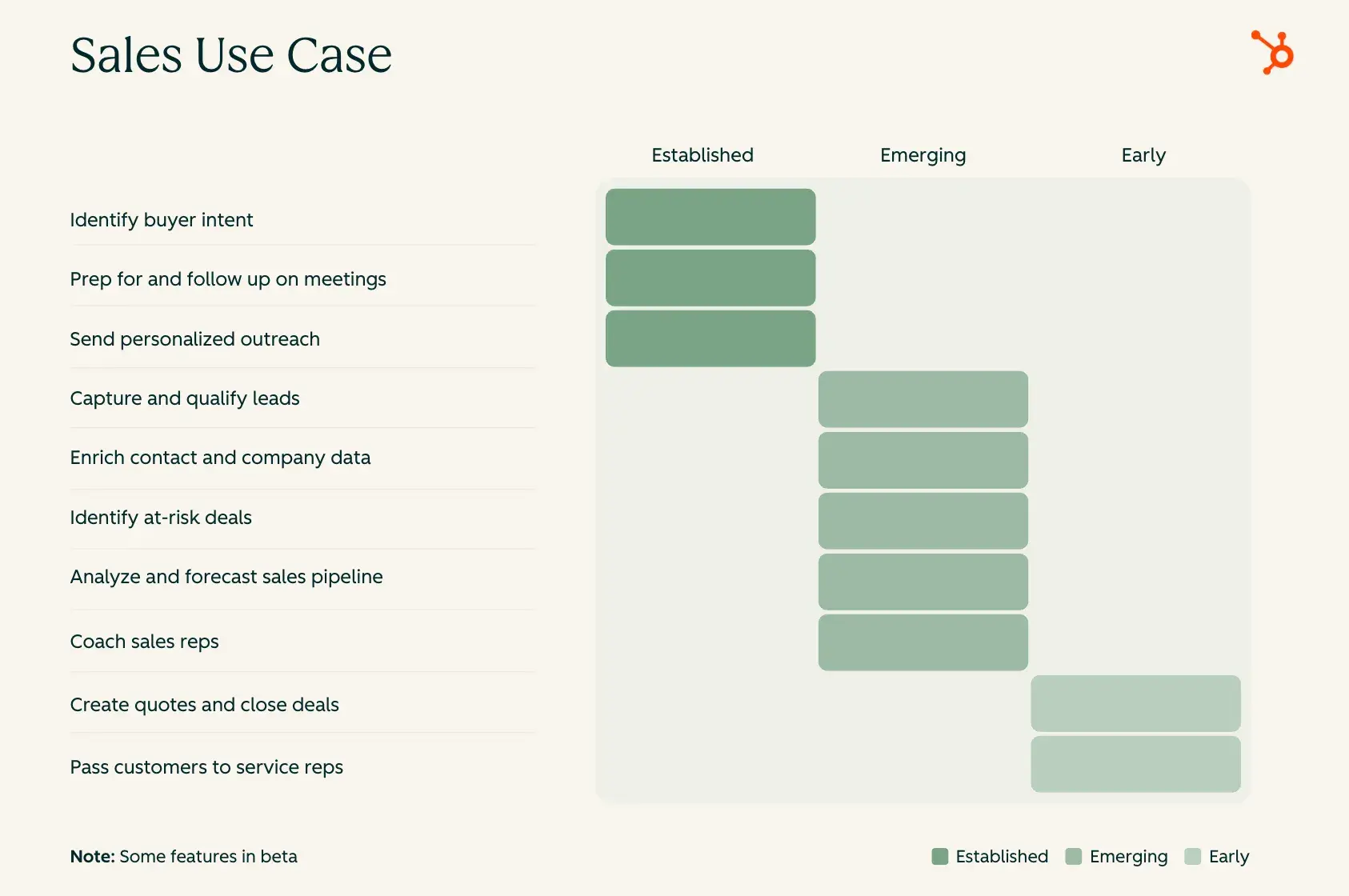
established
Identify buyer intent.. Reps often spend too much time on the wrong accounts – not because they’re bad at their jobs, but because they don’t always know who’s actually ready. AI monitors your target accounts for signals like funding news, new hires, and website visits, and alerts your team when the moment is right. The result is less time chasing cold accounts and more interaction with buyers who are already interested. HubSpot users can start with buyer intent. Learn more
Prepare for and follow through on meetings. Sales reps spend the first few minutes of every call trying to remember where they left things and won’t have time to read after an hour of writing notes. AI fixes both ends of this problem. Before a meeting, it shows contact history, deal context and recent interactions so you’re prepared. After the call, it captures what was discussed, pulls out action items, and automatically drafts a follow-up email. Less time on admin means more time pushing deals. HubSpot customers can get started with Breeze Assistant and Call Recap Agent.
Send personalized access.. Imagine having done the best research, only to email a prospect a moment too late. AI monitors what’s happening on each account, alerts you to change, and drafts outreach that feels timely and relevant, not generic. HubSpot customers who use the Breeze Prospecting Agent are seeing twice the response rate compared to traditional outreach. See how to get started.
emerging
Improve contact and company data. Every salesperson knows the pain of CRM with incomplete records. Missing job titles, company information, and all the fields you need to make segmentation, scoring, and personalization really work. Now, AI can fill them in automatically. For HubSpot users, this means drawing on a dataset of more than 200 million company and buyer profiles that are constantly refreshed. Your team spends less time updating CRM records. And they deliver messages that are relevant and relevant because the data behind it is accurate and current. HubSpot customers can get started with data enrichment today – learn.
Coach sales representative. Your reps shouldn’t miss a deal to learn from this. AI analyzes calls and deal activity to identify what top performers do to win and helps managers quickly replicate this across the team. The result is faster ramp times and a team that wins more consistently. HubSpot customers can get started with Conversational Intelligence and Sales Coach Assistant.
quickly
Create quotes and close deals. Creating quotes is one of the most dreaded parts of a rep’s job because it can slow down a deal. What if AI could answer buyer questions about pricing, generate proposals using past deals, and draft quote emails? AI handling paperwork means your reps can do their best work. At HubSpot, we’re building it to help the most complex businesses so our customers can close deals faster.
Use cases for service.
Service teams are often caught in a difficult position. Customers expect faster and better support, but the headcount to support them isn’t growing at the same pace. The detection teams don’t necessarily work long hours. They’re letting AI handle things that humans don’t need, so their people can focus on the things that do. How is it going today?
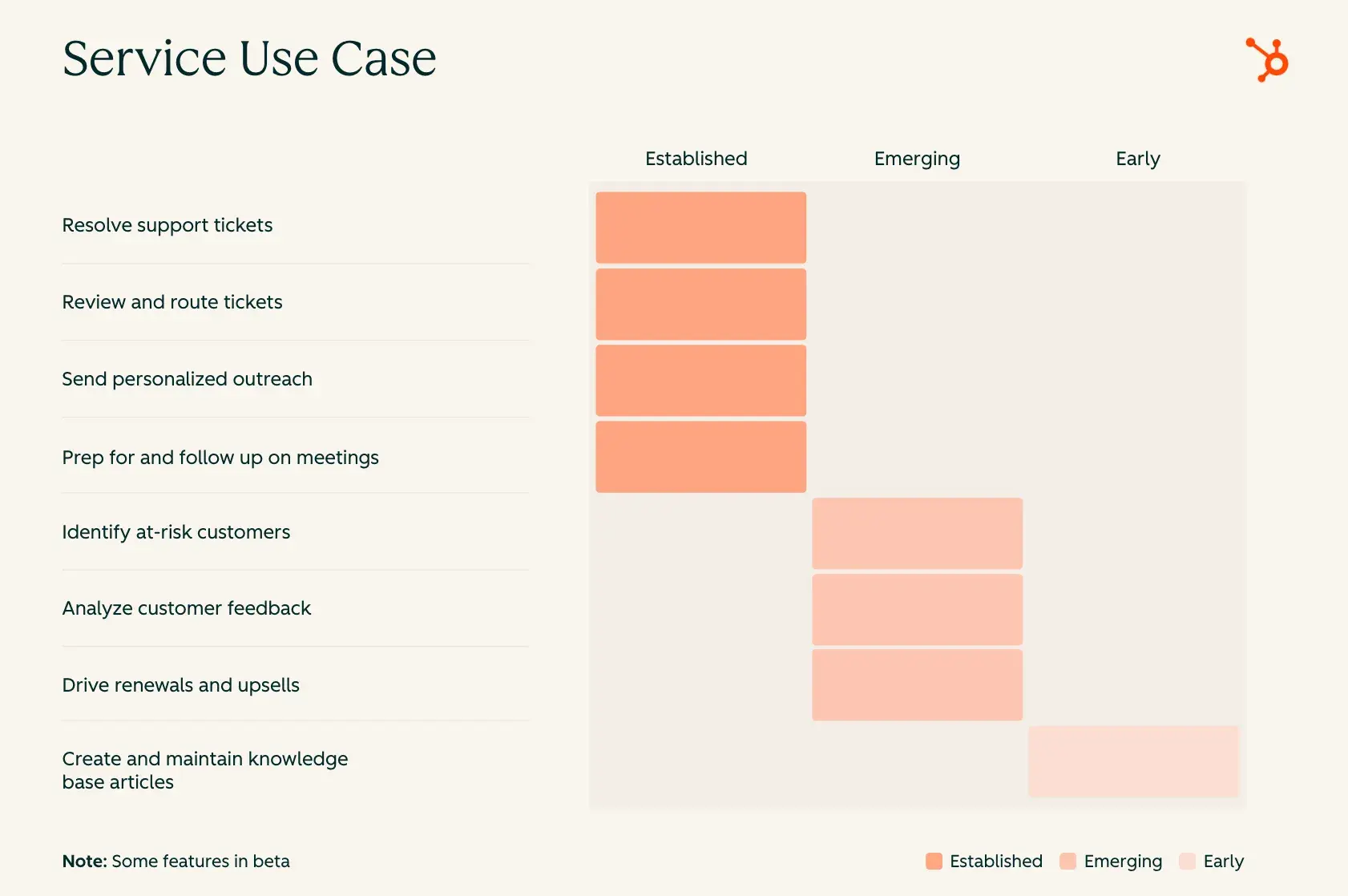
established
Resolve support tickets. Customers shouldn’t have to wait hours for answers to simple questions. AI handles routines instantly using your own help documents, so your team can focus on the problems that actually require a human. HubSpot customers using Breeze Customer Agent are resolving 65% of tickets automatically. Here’s how to get started.
Review and route tickets.. When every ticket looks the same, immediate problems can get buried. This means teams spend more time sorting than solving. AI can help quickly understand, prioritize and assign tickets to the right representative. As a result, the entire team becomes more efficient. HubSpot users using Customer Agent with Help Desk saw a 25% increase in ticket resolution. HubSpot customers can get started with Customer Agent and Help Desk today. See how it works.
Just like in sales, personalized outreach and meeting prep and follow-up are issues that AI can handle for service teams as well. Whether you’re emailing an at-risk customer or preparing for a follow-up conversation, the same AI capabilities help your team stay informed and follow up faster. HubSpot customers can get started with Breeze Assistant.
emerging
Identify at-risk customers.. By the time a customer tells you they’re canceling, you’ve usually already lost them. AI can detect warning signs – a drop in engagement, an increase in ticket volume, a change in tone – and there’s still time to take action. This means better customer satisfaction and better retention. HubSpot customers can use the Customer Health Agent and Conversation Intelligence to get started.
Analyze customer feedback. Your customers are telling you what they need, but it’s buried in hundreds of survey responses and call transcripts. AI automatically scans them all for surface themes and emotional trends, so you can act on what customers are saying instead of guessing. HubSpot users can get started with feedback survey summaries and conversation intelligence.
quickly
Create and maintain knowledge base articles. By the time most of your customer FAQs are written, they are already out of date. So customers get wrong answers, and reps waste time correcting them. With AI, help articles can be drafted based on how your team has resolved tickets in the past – and it can update them when things change. A knowledge base that builds and sustains itself. While it’s still early days, the payoff is clear: better, faster responses to customers and less documentation required from your team.
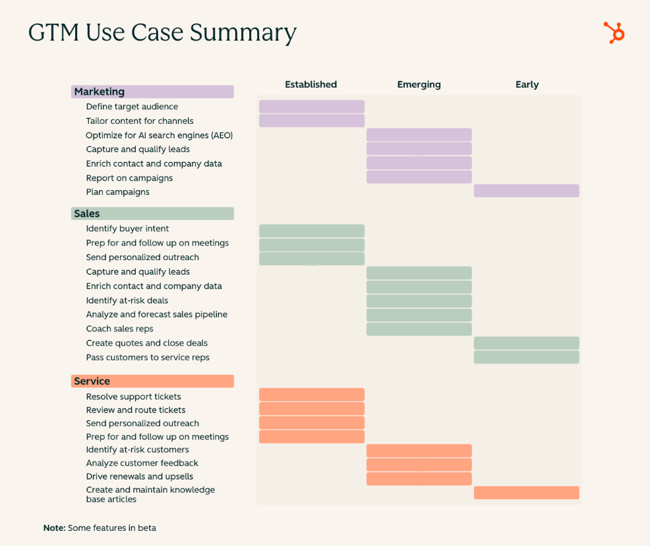
What have we learned?
After working with thousands of clients on how to leverage AI to market from the get-go, the truth we’ve learned is simple: AI doesn’t create speed. Solves a real problem.
Results-driven teams don’t start out with a grand change plan. They started with an obvious hurdle. A place where time was wasted. A workflow that needs to move quickly. Then they put AI to work there.
And the results they see are proving true. Marketing teams are reaching the right audience and converting more visitors into qualified leads. Sales teams are getting twice the response rates on outreach. Customer teams are resolving more than half of their tickets without human intervention. Small beginnings are turning into real, measurable results.
This is why AI is no longer the bet of the future. It is currently working for day-to-day business purposes. It is making work faster, smarter and more efficient.
The question is not whether AI can help your team.
This is where you will start.
