



Heavy rains have triggered deadly floods, damaged crops and dampened tourists across Southeast Asia, with more rain expected early next week.
Floods in southern Thailand have killed at least 13 people and trapped 800,000 households and rubber and palm oil producing areas. In Peninsular Malaysia, more than 16,000 people have been displaced, while floods have claimed 90 lives in central Vietnam.
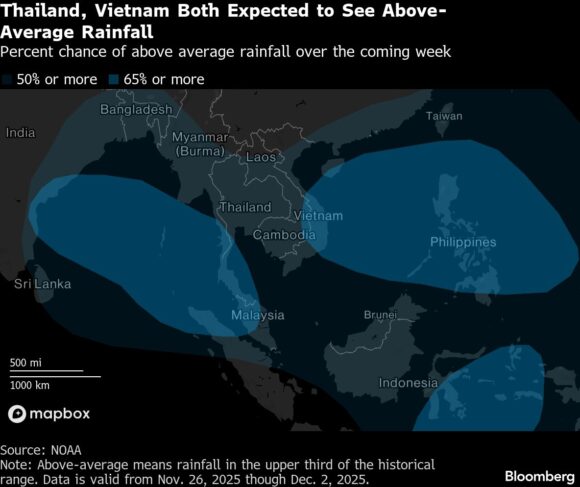
Heavy rains are common for this time of year due to the northeast monsoon, but recent rains have been notable for their intensity and impact. The U.S. National Weather Service predicts above-average conditions for next week in affected areas, including the Philippines, which is still reeling from the effects of a series of typhoons.
The most difficult area in Thailand is the Hat Yai district in Songkhla Province, a commercial hub and transport gateway to the south of the country. It is a popular destination for Malaysian visitors and hosts one of six international airports operated by the country’s largest operator Thailand PCL Airports.
“Our military is immediately mobilizing aircraft, trucks, ships and other vehicles to the flood-affected areas,” Thai Prime Minister Anutin Charnvirkul told reporters on Tuesday. “Water pumps, food, basic necessities and financial resources are already being allocated to these areas.”
Anutin added that he had canceled a planned trip to Malaysia on Wednesday to monitor the floods.
According to the Bangkok Post, more than 4,000 Malaysian tourists are stranded in hotels and at Hat Yai airport, and inbound travel from Malaysia to southern Thailand is to be canceled this week. The neighboring Malaysian state of Kelantan has also been hit by rain.
In central Vietnam, rescue and recovery efforts are underway in four provinces, where economic losses from severe flooding are estimated at more than 13 trillion dong ($493 million).
More than 1,000 homes were destroyed or damaged, more than 80,000 hectares of rice and other crops were destroyed, and more than 3.3 million livestock and poultry were killed or swept away, the government said. The floods also delayed harvesting in Dak Lak province, the country’s largest coffee-growing province.
According to data from the U.S. Climate Prediction Center, affected areas from Vietnam to southern Thailand received above-normal monthly rainfall from Nov. 23 to Nov. 23. This reinforces the risk of flooding, with excess rainfall unlikely to be absorbed by saturated ground.
Image: Flood waters in Hat Yai province, Thailand on November 25, 2025. Photo credit: Arnon Chonhatrakul/AFP/Getty Images
Related:
Copyright 2025 Bloomberg.
Titles
Trends flood
There is interest Flood?
Get automatic alerts for this topic.
